Solutions

Software written by people who sit in the boardroom

Four tools, each born of something our own advisors and analysts needed: a board evaluation platform, Mandate Search for the director looking at seats, Talent Place for the organisation looking for people, and a space to collect and validate governance data. None of them is a survey tool with governance vocabulary bolted on.

0Solutions, one governance record
0+Director & executive profiles
EUHosting and data residency
Board evaluation · for the board

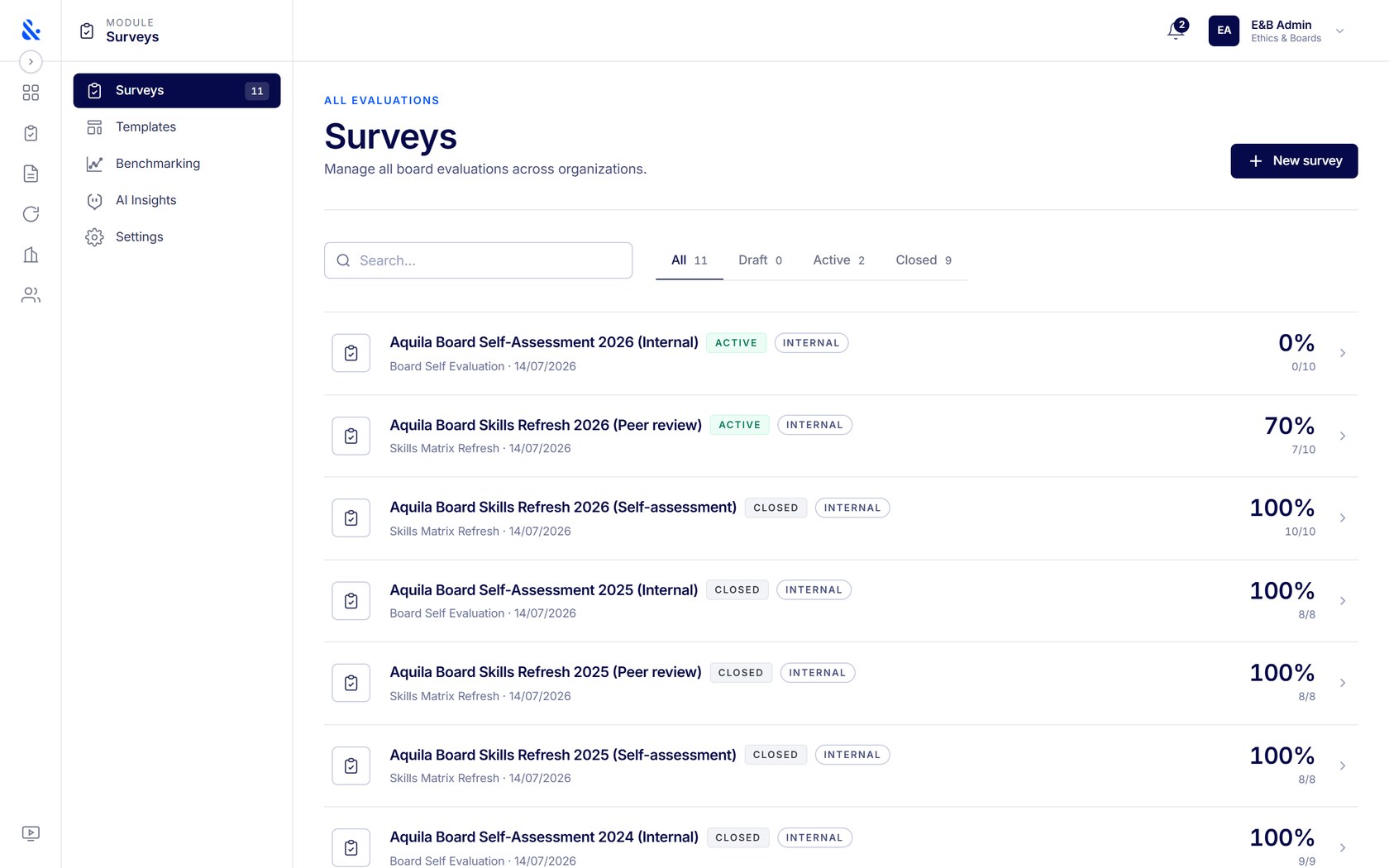
Evaluate, benchmark and strengthen your board

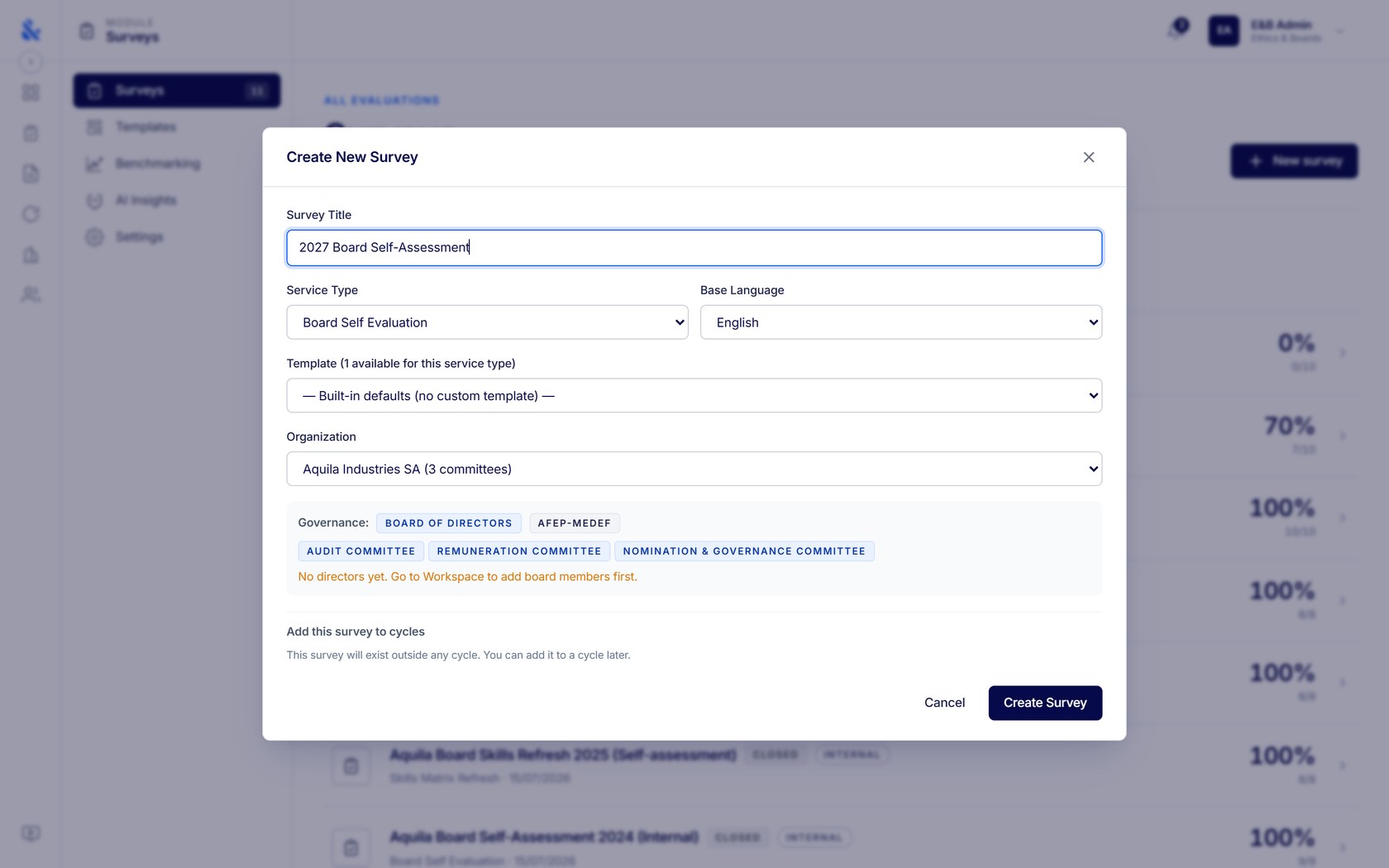
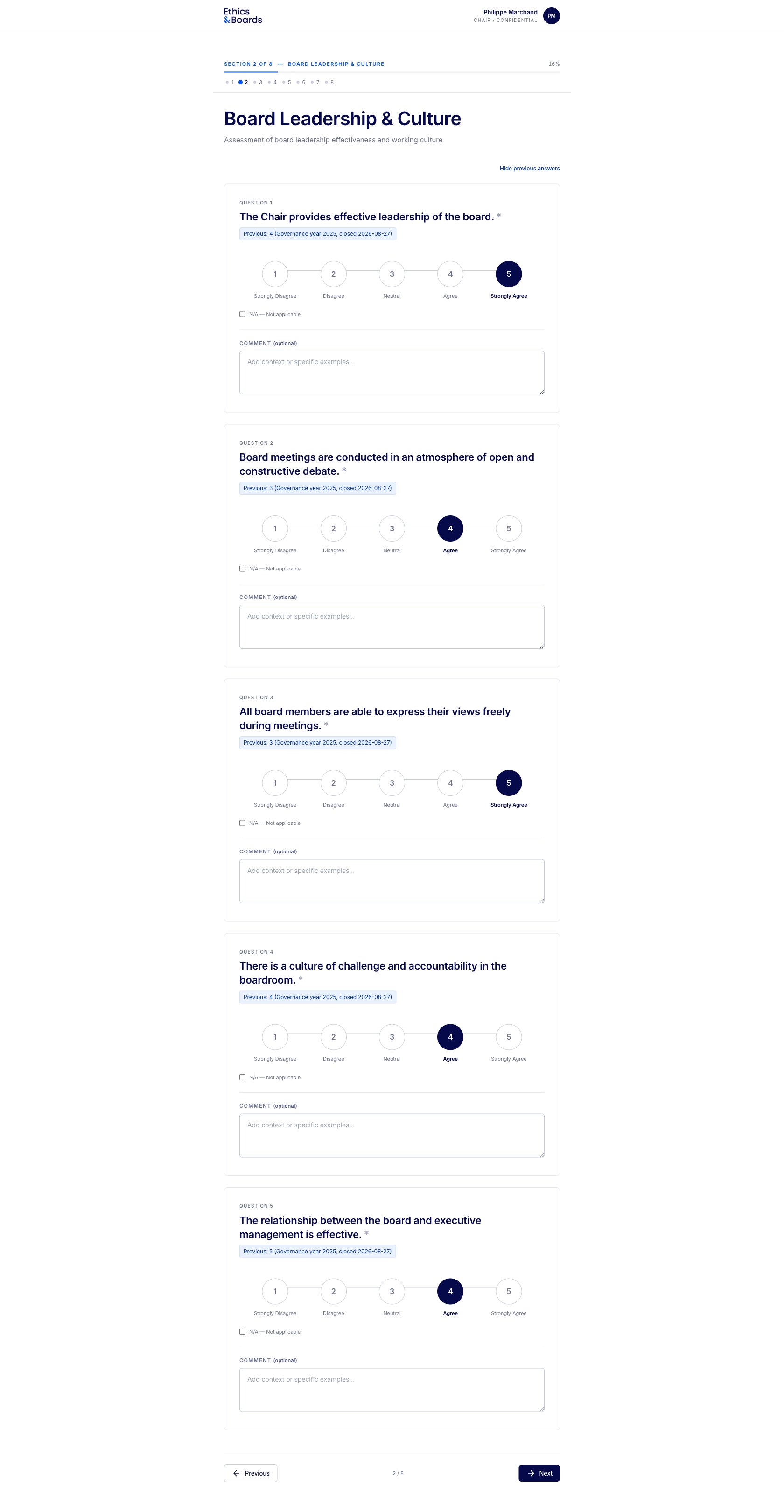
Built by and for board directors and governance professionals. Run the self-assessment, assess director contributions and benchmark your board — in a clear interface, grounded in Gov360 Data.

  • Confidential evaluation campaigns
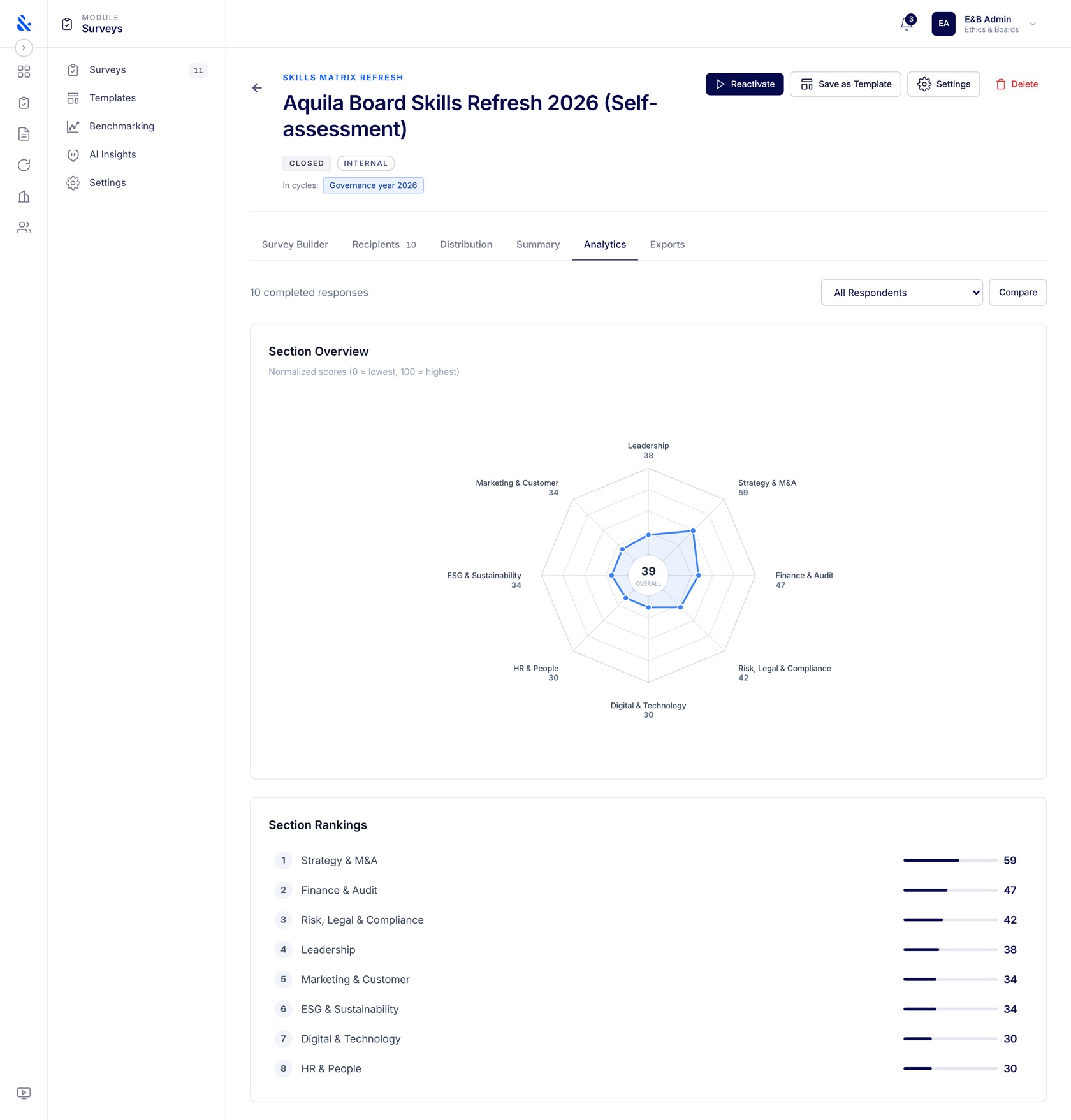
  • Governance practices benchmarked against sector & indices (SBF 120, FTSE 100…)
  • Comparison against our board assessment database
Mandate Search · for the director

The seats that come free are knowable in advance

Board seats are still filled through informal networks, and the opportunity is usually handled before it is officially open. But mandate end dates are disclosed. So is board composition, committee structure, meeting frequency and director remuneration. Mandate Search turns that public record into a single query — the one our own analysts run when a client asks which seats fall vacant, and when. It answers a person's question, not an organisation's: I sit on boards, or I want to, and I need to know where the openings will be.

Step 01
Set the horizon
Terms are searched by the year they end — 2026, 2027, 2028, or no limit at all — and by whether the seat is one the general meeting elects. Everything downstream narrows that first answer.
Step 02
Narrow the company
Index — the whole file, the SBF 120 or the CAC 40 — then sector across fifty-six activities on two levels, then where the registered office sits: Île-de-France, elsewhere in France, or outside it.
Step 03
Narrow the seat
Independent or not, which of eleven committees the seat sits on, the gender of the person holding it, and how long they have held it — a tenure floor and a ceiling, because both ends say something.
Step 04
Read the board behind it
A result is a mandate, and a mandate opens its company: the board split between the members whose term ends inside your horizon and everyone else, with the seat you clicked outlined.
Behind the seat

Pick one mandate and the whole board opens

Not a name and a date — the board you would be joining, and the people already sitting in it.

THE BOARD IN NUMBERSManufacturing · Paris, France
Chair of the boardDirector name withheld
Chief executiveDirector name withheld
14Voting members
9Independent
5Non-independent
9Board meetings in 2025
Total for 100% attendance96,400
Fixed 54,000 € Variable 42,400 €
Committee meetings in 2025
6Audit4Remuneration3Nominations3CSR4Risk

BOARD COMPOSITIONMembers whose term expires before end of 2028
  • 01 Director name withheldIndependent Director · Audit Committee (Chair) Term endsMay 2027 Attendance100%
  • 02 Director name withheldExecutive Chair · Nominations Committee (Chair) Term endsMay 2027 Attendance92%
  • 03 Director name withheldIndependent Director · Audit & CSR Committees Term endsMay 2028 Attendance100%
On each director's own page
  • General experience, functional and sector expertise
  • Every directorship held, listed and unlisted
  • Committee seats, and which ones they chair
  • Board attendance, tenure and term end
Talent Place · for the organisation

One pool, two searches

Mandate Search answers a person's question: which seats come free. Talent Place answers an organisation's: who could hold this one. Same record, opposite direction — and it is not only a board search. The pool serves executive appointments as readily as board ones, which is why its criteria ask separately about what someone has run and where they have sat. And the profile boards look for is moving: geopolitics, cyber risk and AI-led transformation sit on every agenda, and the need is rarely a subject-matter expert — it is a director able to read the environment and decide what it means for the company. Governance for future-proof companies starts with who is around the table.

  • 01Who asks the questionA company filling a key role. An investment firm or portfolio manager looking across the boards of what it holds. A development finance institution attaching governance conditions to a transaction. The search starts from a need already defined, not from a vacancy that has been announced.
  • 02Executive experienceSixteen sectors and thirty-five executive positions grouped in twelve families — chief executive, chief financial officer, and the rest. Each can be asked of a whole career or of recent years only, which is not the same question.
  • 03Board experienceThe same sixteen sectors read from the boardroom: mandates in listed and unlisted companies, chaired or simply held, eleven committees asked separately as chair and as member, and the number of directorships carried — from none to fifteen.
  • 04Who they areGender, age, nationality and geographic expertise, drawn from two hundred and fifty-three countries and grouped by region — so a board that needs someone who has operated in a given market can ask for exactly that.
  • 05What a query returnsNot a ranking, and not a shortlist to defend. A list of people, each with their own page: general experience, functional skills, executive positions past and present, and every directorship with its committees and attendance. What you do with it is approach them.
  • 06How narrow it goesThe pool holds more than 100,000 executives and directors. Industrials brings it to 3,826. A chief financial officer among them, 355. Who has also sat on an audit committee, 35. A woman, 12. Four criteria out of fifteen, and the field is already small enough to pick up the phone.
Data collection · for supervisors and owners

Extracted by machine. Validated by a person.

Some organisations do not want to buy governance data — they have to collect their own, and to be able to show how. A market authority whose issuers file their own governance record; a state ownership agency following a portfolio against a reference framework. We open the space they collect in: the machine reads the filings at scale and brings back each value together with the passage that supports it, and a person validates or rejects it before it counts. What comes out belongs to them, with the trail of who accepted what still attached.

4 0 0
  • Number of voting board members
    12Pending
    Universal Registration Document 2025 · page 148
  • Women on the Board
    41.7%Pending
    Universal Registration Document 2025 · page 149
  • Median CEO pay ratio
    40:1Pending
    Universal Registration Document 2025 · page 214
    Extraction returned 40:1 — the 2024 comparative. The source states 38:1 for 2025. Rejected — back to the queue.
  • Say on Pay ex post — approval rate
    91.3%Pending
    Voting results 2026
A board dashboard is only useful if directors actually open it. We design for the people in the room — and we use the same tools on our own mandates.
0
Solutions, one governance record
0+
Companies in mandate search
EU
Hosting only
0+
Years of board practice behind them
Engage our team

Want to see one of them running?

Demonstrations run on a fictional board by default; if you would rather see your own in it, we set that up under NDA before any commitment. Tell us which of the four brings you, and let's put a screen in front of you.

Stay informed.

Every week, one governance ratio drawn from Gov360 Data — a measured fact on boards, remuneration or ESG, with the context to read it. Plus our studies and press mentions as they are published.

One email a week. Unsubscribe anytime.